For independent properties, Rate Parity in Hotels remains an important part of maintaining pricing consistency, guest trust, and a strong distribution strategy across direct and third-party booking channels. While independent hotels have more flexibility than large hotel groups, that flexibility also makes pricing decisions more complex. A room may be listed on an online travel agency (OTA), the hotel’s website, a metasearch platform, or through offline sales channels, making consistent rate management essential.
What Is Rate Parity in Hotels and Why Does It Matter?
Rate parity refers to maintaining consistent publicly available room rates for the same room type, dates, occupancy, and booking conditions across different sales channels. For an independent hotel, the objective is not simply to display the same number everywhere. It is to create a transparent pricing structure while accounting for legitimate differences such as inclusions, cancellation terms, packages, or member benefits.
When guests see significantly different prices for what appears to be the same room, they may question which channel offers the best value. This can affect trust and influence their final booking decision.
A well-managed parity approach can help hotels:
1. Build greater confidence in displayed room rates.
2. Reduce guest confusion during the booking journey.
3. Maintain better control over distribution channels.
4. Support a consistent brand positioning.
5. Improve the effectiveness of pricing and promotional decisions.
How Does Rate Parity in Hotels Support Independent Hotel Revenue?
For independent properties, pricing is closely connected to demand, occupancy, booking pace, seasonality, and market conditions. Maintaining a clear rate structure gives revenue teams a reliable foundation for making pricing decisions rather than reacting to isolated channel changes.
This is where Revenue Management for Independent Hotels becomes particularly important. Instead of keeping rates fixed, hotels can monitor demand patterns and adjust prices according to the opportunity available for each date.
For example, a hotel may increase rates when demand accelerates for a weekend, event, holiday, or high-demand period. During softer dates, it may introduce targeted offers instead of permanently lowering the public rate.
A consistent pricing framework helps hotels focus on:
1. Demand forecasting and booking pace.
2. ADR and occupancy performance.
3. Rate changes based on market demand.
4. Channel contribution and profitability.
5. Restrictions such as minimum length of stay.
6. Promotional offers for specific customer segments.
The goal is not to offer the lowest price. The goal is to sell the right room, through the right channel, at the right price and time.
Why Should Independent Hotels Care About Rate Parity in Hotels?
Independent hotels often depend on multiple distribution channels to generate visibility and bookings. OTAs can provide market reach, while direct channels can help hotels develop stronger guest relationships and reduce dependence on third-party distribution.
However, inconsistent pricing can create unnecessary channel conflicts. If a guest finds a lower public rate elsewhere, the hotel’s direct booking channel may lose credibility. Conversely, if the direct website consistently offers a better value proposition through transparent benefits, guests have a stronger reason to book directly.
Rate parity should therefore be considered part of a broader Hotel Revenue Strategy, rather than an isolated pricing rule.
Hotels should regularly check:
1. Public rates across major booking channels.
2. Room type and occupancy mapping.
3. Cancellation and payment conditions.
4. Taxes, fees, and inclusions.
5. Promotional discounts and mobile offers.
6. Currency and market-specific pricing.
7. Availability and restrictions.
Does Rate Parity Mean Every Hotel Channel Must Have the Exact Same Offer?
No. Rate parity does not necessarily mean that every channel must provide an identical overall offer in every situation. The important consideration is whether guests are comparing genuinely equivalent products and booking conditions.
A hotel can differentiate its direct channel without simply undercutting public OTA prices. For example, the direct website could provide additional value through benefits that are clearly communicated.
Possible direct-booking advantages include:
1. Flexible cancellation conditions where commercially viable.
2. Complimentary breakfast or another added inclusion.
3. Room upgrade opportunities based on availability.
4. Early check-in or late check-out subject to availability.
5. Loyalty benefits or repeat-guest privileges.
6. Exclusive packages designed specifically for direct customers.
This approach strengthens a Direct Booking Strategy for Hotels while keeping the public pricing structure clear.
How Can Hotels Identify and Fix Rate Parity Problems?
The first step is regular monitoring. Hotels should not assume that rates remain consistent simply because they were uploaded correctly at the beginning of a season.
Rate discrepancies can arise from several sources, including incorrect inventory mapping, outdated promotions, channel-specific discounts, currency differences, or technical distribution issues.
A practical monitoring process can include:
1. Comparing rates for identical dates and room categories.
2. Checking the same occupancy and cancellation conditions.
3. Reviewing taxes and mandatory fees.
4. Testing rates across different devices and booking paths.
5. Checking whether promotions are being applied correctly.
6. Reviewing channel contracts and promotional conditions.
7. Investigating unexpected price differences promptly.
Technology and structured data analysis can make this process more efficient. A revenue management system can also help teams evaluate pricing decisions alongside demand, pickup, and performance data.
How Does Rate Parity Fit Into a Hotel Pricing Strategy?
A strong Hotel Pricing Strategy should go beyond simply matching rates across channels. The bigger question is whether the hotel’s price reflects demand, positioning, guest willingness to pay, and business objectives.
For example, keeping the same rate throughout a high-demand period may protect consistency but leave revenue opportunities untapped. Similarly, lowering rates too aggressively during low-demand periods can damage ADR without generating enough incremental occupancy.
A stronger pricing process considers:
1. Historical demand patterns.
2. Current booking pace.
3. Competitor positioning.
4. Seasonality and local events.
5. Length of stay.
6. Room-type demand.
7. Cancellation trends.
8. Channel profitability.
9. Forecasted occupancy.
This allows independent hotels to treat parity as one part of a wider commercial strategy rather than a standalone pricing exercise.
Can Revenue Management Help Independent Hotels Maintain Better Pricing Control?
Yes. Revenue management combines market information, historical performance, demand signals, and booking data to support more informed pricing decisions.
For independent hotels, this can be particularly useful because smaller teams may not have dedicated revenue managers monitoring every channel throughout the day.
A structured revenue management process can help identify:
1. Dates where rates can be increased.
2. Dates where demand needs stimulation.
3. Booking pace that differs from historical patterns.
4. Opportunities to improve room-type pricing.
5. Distribution channels producing stronger returns.
6. Potential gaps between demand and available inventory.
Revnomix provides revenue management services that use data, market analysis, dynamic pricing, and business intelligence to support hotel decision-making. Its service offering includes a dedicated team, business intelligence capabilities, and data-driven revenue processes.
What Should Independent Hotels Do to Build a Stronger Pricing Process?
Hotels should begin by creating a clear pricing framework and documenting how rates are managed across channels. The process should define who monitors rates, how often discrepancies are checked, and which situations require pricing changes.
The next step is to connect parity monitoring with revenue performance. A rate difference should not automatically trigger a price reduction. Instead, the hotel should investigate why the difference exists and whether it affects profitability, conversion, or brand positioning.
An effective process can include:
1. Daily or scheduled rate checks.
2. Weekly performance reviews.
3. Monthly pricing strategy assessments.
4. Demand forecasting for key dates.
5. Regular channel profitability analysis.
6. Tracking direct booking contribution.
7. Reviewing promotions before launch.
8. Monitoring guest booking behaviour.
For regular updates, visit our Facebook and Instagram profiles.
Why Is Rate Parity Still Relevant for Independent Hotels?
Rate parity remains relevant because guests have more ways to compare hotel prices than ever before. Independent hotels need to manage these comparisons while protecting their revenue opportunities and maintaining a credible direct booking experience.
The key is to avoid treating parity as a rigid rule that prevents hotels from adapting prices. Instead, it should form part of a broader Hotel Revenue Strategy that combines pricing intelligence, distribution management, demand forecasting, and direct-channel growth.
When these elements work together, independent hotels can maintain pricing clarity without sacrificing the flexibility required for effective revenue optimisation.
Ready to Strengthen Your Hotel’s Revenue Strategy?
Book a consultation or contact Revnomix to discuss a data-driven approach to hotel pricing, distribution, and revenue optimisation.
Frequently Asked Questions
Q1: What is Rate Parity in Hotels?
Ans: Rate Parity in Hotels means maintaining consistent publicly available room rates for comparable rooms, dates, occupancy, and booking conditions across different sales channels. It helps reduce guest confusion, supports pricing transparency, and strengthens overall distribution management.
Q2: Why is rate parity important for independent hotels?
Ans: Rate parity helps independent hotels maintain pricing consistency across their website, OTAs, and other channels. It can support guest trust, reduce channel conflicts, and create a stronger foundation for revenue decisions without preventing hotels from using targeted promotions.
Q3: Does rate parity mean hotels cannot offer direct booking benefits?
Ans: No. Hotels can create additional value for direct bookings through benefits such as flexible policies, packages, upgrades, or other inclusions. The key is to communicate the differences clearly while maintaining a transparent public pricing structure.
Q4: How often should hotels check their rates for parity?
Ans: Hotels should monitor rates regularly, particularly during peak seasons, promotions, major events, and periods of changing demand. Automated monitoring combined with scheduled manual checks can help identify unexpected discrepancies and distribution issues quickly.
Q5: How does revenue management improve hotel pricing?
Ans: Revenue management uses demand, booking pace, historical performance, market conditions, occupancy, and other data to support pricing decisions. It helps hotels move beyond fixed rates and identify opportunities to improve ADR, occupancy, and overall revenue performance.
Summary
Article Name
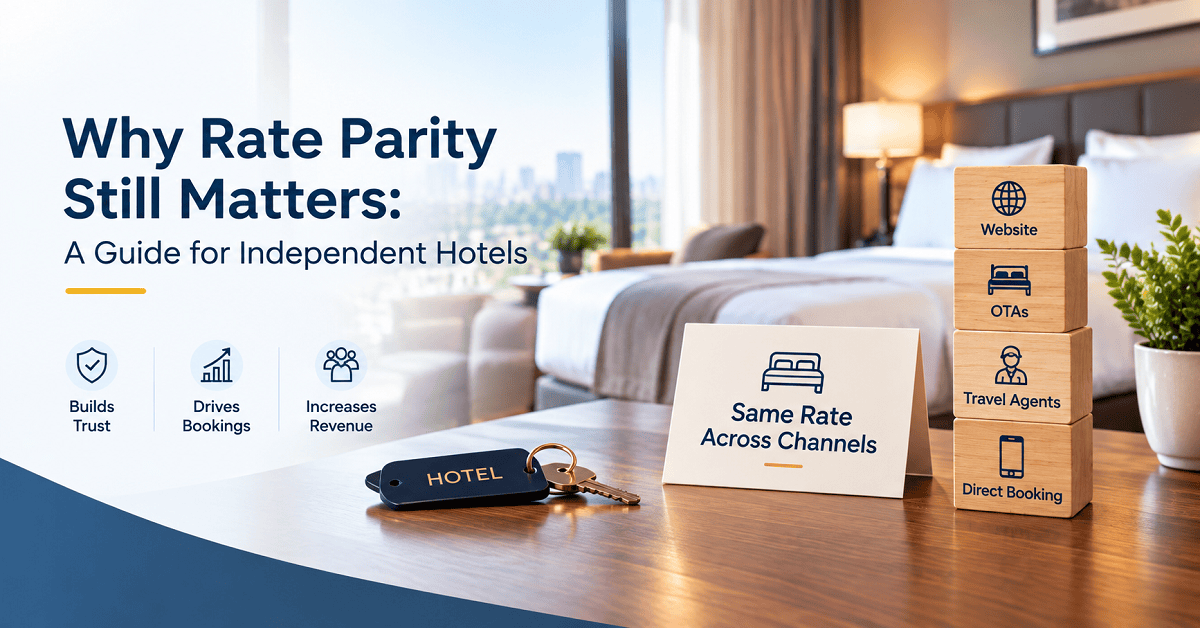
Why Rate Parity Still Matters: A Guide for Independent Hotels
DescriptionUnderstand why Rate Parity matters for independent hotels and how consistent rates across booking channels can improve trust, bookings, and revenue.
Publisher Name
Revnomix solutions LLP
Publisher Logo