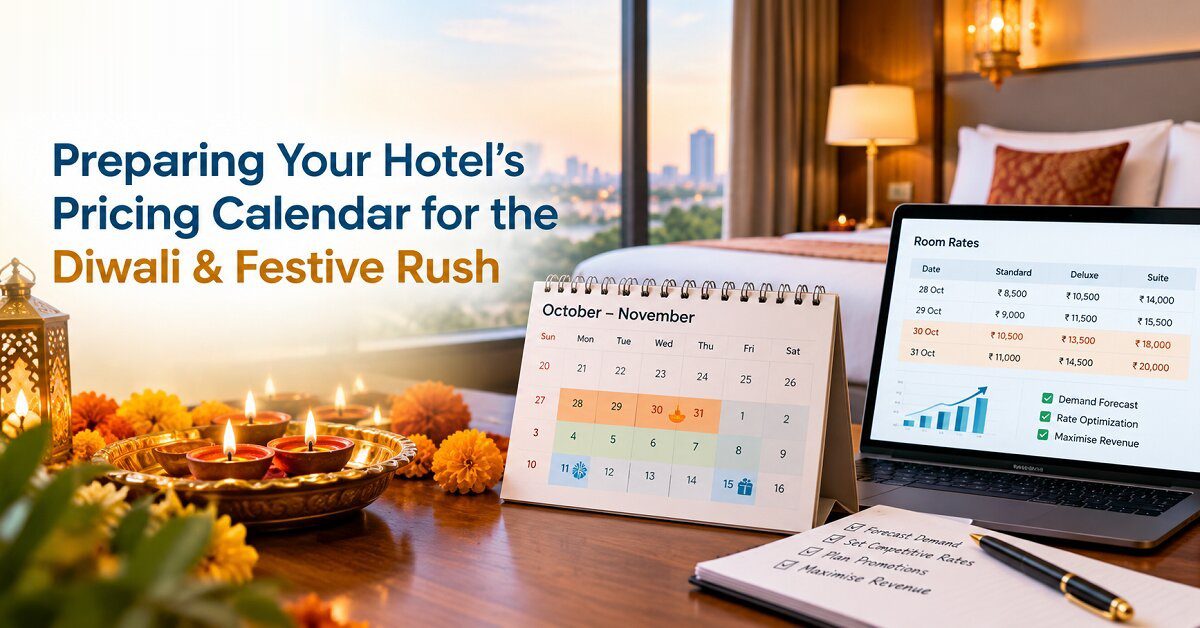
As Diwali and the festive season approach, hotels need a proactive approach to pricing, demand forecasting, and inventory management. A well-planned Hotel’s Pricing Calendar can help properties anticipate demand, adjust room rates at the right time, and maximise revenue during one of the busiest periods of the year.
What Should a Hotel’s Pricing Calendar Include for Diwali?
A hotel’s pricing calendar should provide a clear view of expected demand, room rates, restrictions, promotions, and inventory for each important date during the festive period. Instead of treating Diwali as a single high-demand day, hotels should plan for the entire booking window around the celebration.
The calendar should consider:
1. Diwali and associated festive dates.
2. Weekends and extended holiday periods.
3. Expected occupancy levels.
4. Historical booking patterns.
5. Local events and celebrations.
6. Room-type availability.
7. Booking lead times.
8. Cancellation trends.
This information gives revenue teams a structured foundation for making pricing decisions before demand peaks.
How Early Should Hotels Start Planning Their Hotel’s Pricing Calendar?
Hotels should ideally begin festive pricing preparations several weeks or months before the expected demand surge. Waiting until occupancy rises significantly can mean missing opportunities to capture higher-value bookings.
An early planning process allows hotels to identify important dates, establish initial rates, and create pricing triggers based on booking pace.
A useful preparation timeline can include:
1. Early planning: Identify festive dates and review historical performance.
2. Pre-season: Set initial rates and forecast demand.
3. Booking acceleration: Monitor pickup and adjust rates.
4. Peak period: Apply dynamic pricing and inventory controls.
5. Post-festive period: Review results and update future forecasts.
The exact timeline will vary depending on the hotel’s location, customer segments, historical demand, and booking behaviour.
How Can a Hotel’s Pricing Calendar Support Better Revenue During Diwali?
A pricing calendar becomes more valuable when it is connected to real-time demand signals. If bookings begin accelerating faster than expected, rates can be increased gradually rather than waiting until the hotel is nearly sold out.
This is an important part of a Hotel Pricing Strategy for Diwali, because festive demand can change quickly. Guests may book earlier than usual for popular destinations, while corporate or leisure demand may behave differently depending on the market.
Hotels can monitor:
1. Occupancy and pickup by date.
2. Average daily rate (ADR).
3. Booking lead time.
4. Remaining room inventory.
5. Cancellation and modification patterns.
6. Demand by room category.
7. Direct and third-party booking contribution.
The objective is to capture increasing willingness to pay while avoiding unnecessary rate increases that could negatively affect conversion.
What Is a Good Diwali Hotel Pricing Strategy?
A strong Diwali Hotel Pricing Strategy should be based on demand rather than simply applying a fixed festive-season markup. Different dates can experience different levels of demand, even within the same holiday period.
For example, the night before Diwali, Diwali night, weekends, and dates immediately following the celebration may have different booking patterns.
Hotels can create pricing tiers based on expected demand:
1. Base festive rate for moderate-demand dates.
2. Higher rate for dates showing strong pickup.
3. Premium pricing for peak-demand nights.
4. Special packages where additional value can improve conversion.
5. Strategic offers for dates where demand remains soft.
This approach allows the hotel to remain flexible while protecting revenue potential.
How Should Hotels Adjust Room Rates as Diwali Demand Increases?
Hotels should avoid making large pricing changes without analysing booking pace and remaining inventory. Incremental adjustments can provide better control over revenue performance.
If a particular date is filling faster than forecast, the hotel can gradually increase rates or introduce restrictions. If demand remains weaker than expected, targeted promotions may be considered instead of reducing the base rate across all channels.
Important pricing signals include:
Faster-than-expected booking pickup.
Limited availability in popular room categories.
Increasing search and booking activity.
Higher-than-usual average booking value.
Strong demand for specific arrival dates.
Changes in cancellation behaviour.
This makes dynamic pricing an essential component of a Diwali Pricing Strategy for Hotels.
Should Hotels Create Separate Rates for Different Festive Dates?
Yes. Treating every festive date identically can limit a hotel’s ability to respond to variations in demand. Each date should ideally have its own demand forecast and pricing position.
A Hotel Pricing Strategy for the festive season should account for the hotel’s individual market rather than relying only on broad assumptions about Diwali demand.
Hotels should analyse:
1. Which dates historically generate the highest occupancy.
2. Which dates attract longer stays.
3. Which room types sell fastest.
4. Which customer segments book during the festive period.
5. Which dates need additional demand stimulation.
This date-level approach can help hotels make more precise pricing decisions.
How Can Hotels Use Packages Without Undermining Their Pricing?
Festive packages can add value without requiring hotels to heavily discount their rooms. Instead of reducing the headline room rate, properties can bundle relevant benefits such as meals, festive experiences, extended stays, or other services.
However, packages should be designed carefully and evaluated based on their total revenue contribution.
Before launching a package, hotels should consider:
1. The actual cost of included benefits.
2. Expected increase in booking conversion.
3. Length-of-stay potential.
4. Target customer segment.
5. Availability during peak dates.
6. Impact on average room revenue.
Packages should complement the pricing strategy rather than replace demand-based rate management.
How Can Technology Improve Festive Pricing Decisions?
Managing festive pricing manually across multiple dates and room categories can become challenging, particularly when demand changes rapidly. Revenue management technology can help hotels monitor performance and identify when pricing adjustments may be required.
Automated data analysis can support decisions around forecasting, demand trends, rate changes, and inventory availability.
A technology-supported approach can help revenue teams:
1. Monitor booking pace.
2. Analyse historical demand.
3. Track occupancy trends.
4. Identify high-demand dates.
5. Support dynamic rate adjustments.
6. Review performance against forecasts.
Revnomix helps hotels use data-driven revenue management practices to improve pricing and forecasting decisions during changing demand periods.
What Mistakes Should Hotels Avoid When Preparing for Diwali?
One of the biggest mistakes is waiting for demand to become obvious before adjusting prices. By that stage, a significant portion of high-value bookings may already have been captured at lower rates.
Hotels should also avoid applying the same strategy to every date and every room category.
Common mistakes include:
1. Setting festive rates too late.
2. Using one rate for the entire holiday period.
3. Ignoring booking pace.
4. Discounting too early.
5. Failing to monitor room-type demand.
6. Overlooking direct booking opportunities.
7. Not reviewing pricing performance after the festive period.
A disciplined calendar combined with regular forecasting reviews can help reduce these risks.
How Can Hotels Build a Stronger Diwali Pricing Strategy for Hotels?
Hotels should begin with historical data, identify demand patterns, establish initial pricing levels, and define clear triggers for rate changes. The calendar should then be reviewed regularly as new bookings and market signals become available.
The strongest approach is not simply to charge more during Diwali. It is to understand when demand is increasing, how quickly inventory is being consumed, and what guests are willing to pay at different points in the booking cycle.
This allows hotels to make informed decisions while protecting both occupancy and ADR.
For regular updates, visit our Facebook and Instagram profiles.
Ready to Optimise Your Festive Hotel Revenue?
Book now or contact Revnomix to discuss a data-driven approach to festive pricing, forecasting, and revenue management for your property.
Frequently Asked Questions
Q1: What should a Hotel’s Pricing Calendar include for Diwali?
Ans: A Hotel’s Pricing Calendar should include festive dates, expected demand, room availability, historical booking patterns, occupancy forecasts, rate levels, restrictions, promotions, and booking pace. Reviewing these factors regularly helps hotels adjust pricing as demand changes.
Q2: When should hotels increase rates for Diwali?
Ans: Hotels should consider increasing rates when booking pace accelerates, occupancy rises faster than forecast, or availability becomes limited. Rate increases should be based on actual demand signals rather than applying a fixed festive markup too early.
Q3: What is the best Diwali Hotel Pricing Strategy?
Ans: The best Diwali Hotel Pricing Strategy combines historical data, demand forecasting, booking pace, occupancy, room availability, and customer behaviour. Dynamic pricing allows hotels to adjust rates according to demand instead of maintaining one fixed price throughout the festive period.
Q4: How can hotels maximise revenue during the festive season?
Ans: Hotels can maximise revenue by forecasting demand early, adjusting rates dynamically, controlling inventory, using targeted packages, and monitoring booking pace. A well-structured festive pricing plan can help capture higher-value bookings while maintaining healthy occupancy.
Q5: Why is a Hotel’s Pricing Calendar important for festive demand?
Ans: A Hotel’s Pricing Calendar gives revenue teams a structured view of upcoming demand and pricing opportunities. It helps hotels plan rates in advance, identify high-demand dates, respond to booking trends, and avoid leaving potential revenue on the table.
Summary
Article Name
Preparing Your Hotel's Pricing Calendar for the Diwali & Festive Rush
DescriptionPrepare your Hotel's Pricing Calendar for Diwali and festive demand with smart pricing strategies to boost occupancy, revenue, and profitability.
Publisher Name
Revnomix solutions LLP
Publisher Logo